

One of the Greenest Festivals in Europe

No more excuses: sustainability is the only way forward.
We are optimists, and we think the future can be bright if we put in the effort. We must take sustainability seriously, knowing that a music event can negatively impact the surrounding air, soil, water, resources, and inhabitants. That’s why we think it’s important to lead by example, improve ourselves year after year, and know that we still have a long way to go.
Through socially responsible entrepreneurship, we strive to achieve our vision by inspiring our visitors and partners to take action in their own lives and communities, ultimately leading to a more sustainable future for all. For more details and data about our sustainability efforts, we kindly direct you to A Greener Festival’s extensive reporting below.
Being honest about where we stand
We believe in being open and honest about our impact, because only by critically examining it can we continue to improve. This year, the picture is mixed.
Our overall carbon footprint increased to 195 t CO2e, up from 127 t CO2e in 2024. The main driver is clear: Paradies Garten welcomed 36% more visitors in 2025, which naturally leads to higher total emissions. What matters to us is the direction of the per-person numbers, and there, the picture is more encouraging. Emissions per person per day rose only modestly, from 12.4 to 13.9 kg CO2e. And emissions from event production per person per day continued to fall, from 6.59 to 5.47 kg CO2e, showing that we’re getting more efficient as we grow.
The area where we still have the most work to do is audience transport. Travel accounts for 61% of our total footprint, and 2025 saw a slight shift away from train travel towards cars, partly due to heavy rainfall on the festival days. 68% of our visitors still travelled by train, which we’re proud of, but we know we need to keep making the sustainable option as easy as possible.



Key findings
Attendance and emissions
The 2025 carbon footprint was 195 t CO2e. While this is higher than the 127 t CO2e recorded in 2024, visitor numbers increased by 36%, from around 6,200 to 8,412 unique visitors. Total emissions grew, but not proportionally - a sign that the work we do on efficiency and data quality is having an effect.
Audience travel remains our biggest challenge
Transport to and from the festival accounts for 61% of our total footprint. In 2025, we saw a lower rate of train use and an increase in car travel compared to the previous year. We believe this was partly influenced by heavy rainfall, which may have led some visitors to choose the car over public transport. We continue to invest in making train travel the most attractive option - and 68% of our audience still chose it.
Promoting public transport
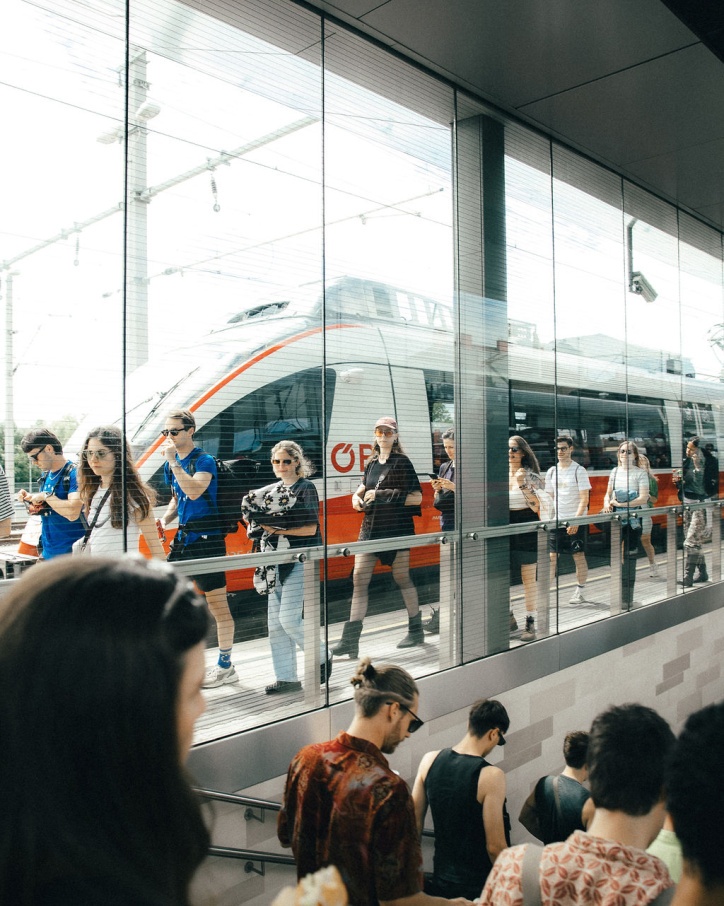
We continue to work closely with ÖBB to promote sustainable travel to and from Bruck an der Leitha. Free night trains remain a central part of our mobility offer, and we will continue to build on this partnership in the years ahead.
Artist travel
In 2025, emissions per act decreased to 198 kg CO2e, down from 318.9 kg CO2e in 2024, despite hosting more international artists. This was partly due to shorter average flight distances and a clear shift among local artists, who in 2025 travelled exclusively by train or festival shuttle, with no private car travel reported. We continue to prioritise booking local and regional artists, and artists already touring in Austria or nearby, as one of the most effective ways to reduce this part of our footprint.
Clean energy
Paradies Garten has run entirely on grid electricity since 2023, with no power generators on site. In 2025, the festival used 9,143 kWh supplied by EVN. Austria benefits from one of the lowest grid carbon intensities in Europe, and the festival site is located in a region with a strong presence of wind energy, making electrification one of our most impactful sustainability decisions.
A meat-free food court
Since the very beginning, our food court has been 100% vegetarian and vegan, reflecting our commitment to reducing the environmental footprint of what we eat. In 2025, the average carbon footprint per serving decreased from 0.53 to 0.44 kgCO2e, thanks to a menu with a greater share of plant-based dishes. We work closely with food partners who share our values, prioritising locally sourced, seasonal and organic ingredients where possible.
Waste
Total waste generated was 11.9 tonnes, a slight increase in line with higher attendance. But waste per person per day continued its downward trend, falling from 0.99 kg in 2024 to 0.85 kg in 2025, and our recycling rate improved from 30% to 34%. We’re moving in the right direction.
Production materials
Most of the materials used at Paradies Garten 2025 were reused from Paradise City, borrowed, or rented, significantly reducing the need for new purchases. Only the main stage was built entirely new. Reusing infrastructure across our sister festivals is one of the most effective ways we reduce the production footprint of both events.



Creating awareness
Paradies Garten is not just committed to making changes within the organisation of our event; we also strive to inspire others. We are aware that some organisations use big words with little impact to boost their image. We believe that open and transparent communication, both the good and the bad, is the only way forward.
Since 2022, we have expanded our citizenship campaigns and safer space policy, aiming to strengthen a more positive and resilient festival culture. One of these initiatives is our Citizenship Manifesto, which seeks to embed diversity and inclusivity into our team and lineup. Our entire core team participates in dedicated workshops on these themes.
Our booking policy focuses on three criteria: increasing the share of local artists, female-identifying artists, and POC artists. We don’t use quotas, but we believe that more diversity and equity in our lineup benefits the festival in every way possible.
In 2022, we launched the Angels of Paradise; a team of trained, easily identifiable volunteers present throughout the festival grounds, ready to listen, assist and support anyone in distress. We continue to grow and improve this initiative every year.